A Messenger Built on Speed, Scale, and Independence
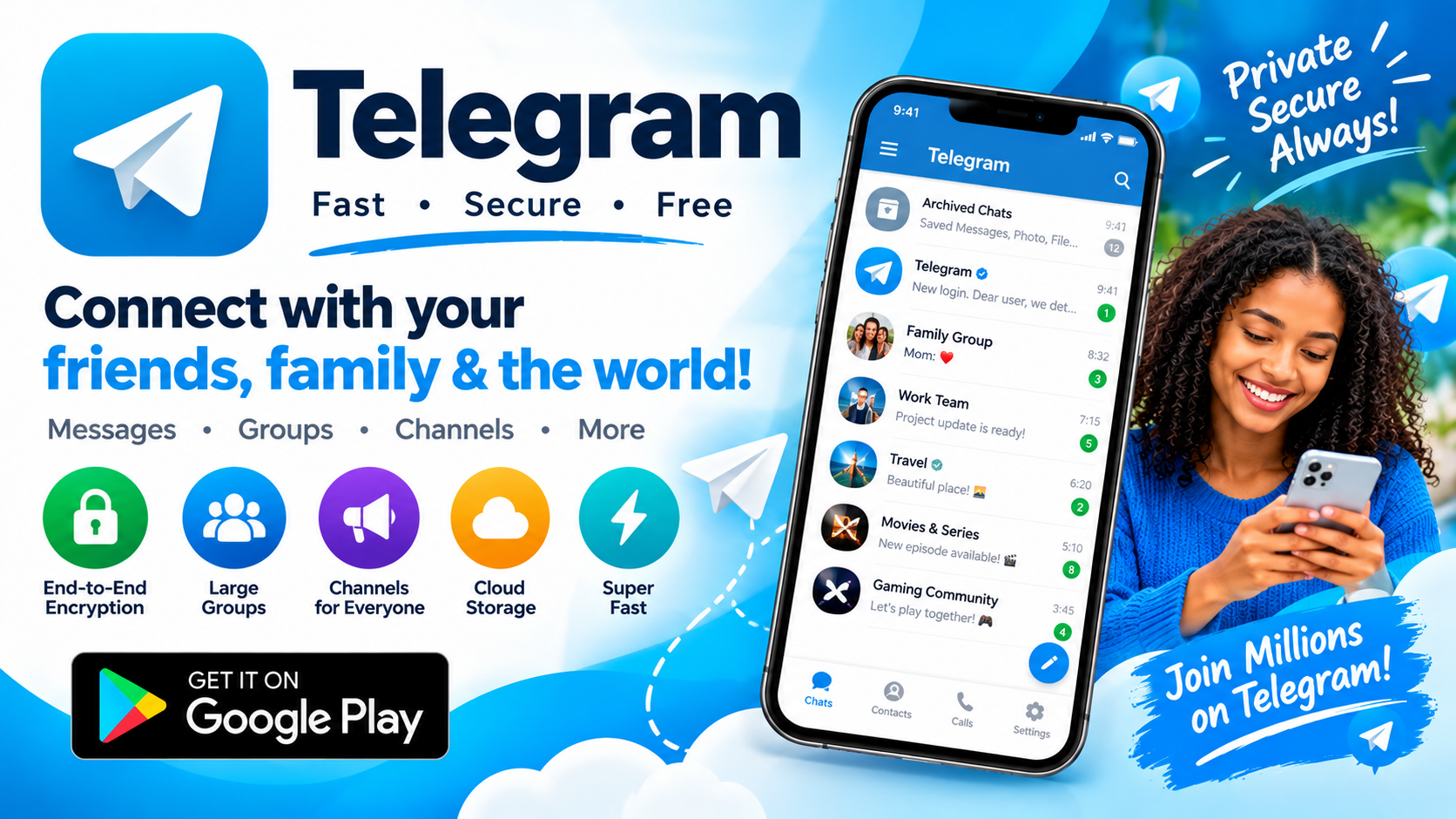
Telegram isn't a newcomer, but it has grown into something remarkable: one of the top five most downloaded apps in the world, with more than one billion active users worldwide . Published by Telegram FZ-LLC and based in Dubai, the app has positioned itself as the anti-establishment choice in a market dominated by Meta and Apple. Its core promise is simple — "pure instant messaging" that's fast, secure, and synced across every device you own. But the real story of Telegram is that it has evolved far beyond messaging into something closer to a platform: communities, channels, bots, file storage, and a publishing ecosystem all wrapped in a single, remarkably lean interface. The Google Play listing describes it as "a messenger focused on speed and secure communication," and that phrase captures the essence of what Telegram has been building for over a decade .
Speed and Sync: The Foundation Everything Else Rests On
The first thing any Telegram user notices is how fast it feels. The app is built on a distributed data center network that the developer claims is unique in the market, designed specifically to minimize latency regardless of where you are in the world . Messages send and arrive almost instantly, even on weak mobile connections — the app claims to be "the most reliable messaging system ever" and to work "even on the weakest mobile connections" . But the more transformative feature is sync. Telegram apps are fully independent, meaning you don't need your phone to be online or even turned on to use it on a tablet or desktop. Start typing a message on your laptop, finish it on your phone, and pick up the conversation later on your tablet. Your entire chat history lives in Telegram's cloud rather than on your device, so it doesn't consume local storage and it survives device changes and reinstalls. That architecture has a downside — as we'll see in the login discussion — but the daily experience is genuinely seamless.
Unlimited File Sharing and Large Communities
Where Telegram decisively outperforms its rivals is in what it lets you send and how many people you can send it to. The limits are dramatically higher than most competitors:
- Group size: Up to 200,000 members in a single group chat
- File size: Up to 2 GB per file, of any type — including .DOCX, .MP3, .ZIP, and video
- File types: No restrictions on format
- Storage: Chat history stored in the cloud, not on your device
- Bots: Custom automation tools can be set up for specific tasks within groups
For anyone who has ever tried to share a large video file through a mainstream messenger and hit an arbitrary size limit, Telegram's approach is liberating. The app markets itself as "the perfect tool for hosting online communities and coordinating teamwork," and the group size limit backs that up . Channels — one-to-many broadcast feeds — have also become a major part of the Telegram ecosystem, used by everyone from independent media outlets to hobbyist communities to distribute content at scale.
Security Architecture: Encrypted by Default, With a Caveat
Telegram's security model is more nuanced than its marketing sometimes suggests, and understanding the distinction matters. Here's how it actually works:
- Cloud chats (default): All content, including chats, groups, and media, is encrypted using a combination of 256-bit symmetric AES encryption, 2048-bit RSA encryption, and Diffie-Hellman secure key exchange. This protects data in transit and on Telegram's servers — but Telegram itself holds the keys.
- Secret Chats (opt-in): For maximum privacy, users can start a Secret Chat, which uses true end-to-end encryption so that only the intended recipient can read the message. Secret Chats also support self-destructing messages, photos, videos, and files, and are programmed to auto-delete from participating devices.
The practical takeaway: if you want end-to-end encryption on Telegram, you have to deliberately enable it by starting a Secret Chat. Regular chats are encrypted, but not end-to-end. Telegram is transparent about this, and its stance that it will "never let any third party access your data" and "never use your data to show you ads" is a meaningful commitment in an era where advertising-driven data collection is the norm . For developers and privacy advocates, Telegram's open API, open-source apps, and reproducible builds add another layer of verifiability — you can confirm that the app you downloaded was built from the published source code.
The Login Problem: Telegram's Most Persistent Frustration
For all its strengths, Telegram has a well-documented Achilles' heel: account recovery and login. This is the single most common complaint among long-term users, and the Google Play reviews make it vivid. Multiple reviewers describe the same painful scenario: after uninstalling the app or resetting their phone, logging back in becomes an ordeal. The verification code is sometimes sent to an old device that no longer exists. SMS codes don't arrive. In some cases, users are told they need to pay for an SMS to complete verification — a particular problem for users without international payment methods . One reviewer who has used Telegram for years put it plainly: "The software itself is really great — messages sync fast, features are rich, speed is stable, so I've used it for many years. But the recent login mechanism has caused trouble for a lot of users." Another described the relief of finally recovering an account after a long struggle. The frustrating part is that these are often solvable problems, and the developer's own recovery tools exist — but the user experience during that process is far from smooth, and it's the one area where Telegram consistently loses goodwill with its most devoted users.
The Ecosystem: Themes, Stickers, Bots, and Bots
Telegram's "fun" features are often underestimated, but they're a major reason the app retains users. The platform offers powerful photo and video editing tools, animated stickers and emoji, fully customizable themes that change the app's appearance, and an open sticker and GIF platform that lets anyone create and share expressive content . Bots are the sleeper feature: developers can build automated accounts that handle tasks — from customer service to polls to file conversion to community moderation — and integrate them directly into group chats. For power users and community managers, bots turn Telegram from a messenger into a lightweight automation platform. The interface, meanwhile, remains intentionally simple. The developer states that while offering an unprecedented range of features, they take care to keep the interface clean — "Telegram is so simple you already know how to use it." That balance between depth and accessibility is genuinely difficult to achieve, and it's a big part of why the app has grown so large without alienating casual users.
The Verdict: Essential, Imperfect, and Still the Best at What It Does
Telegram earns its billion users. Speed, cloud sync, unlimited file sharing, large groups, channels, bots, customizable themes, and a genuine commitment to not monetizing user data make it the most capable messenger available. The security architecture is solid — with the important nuance that end-to-end encryption is opt-in through Secret Chats rather than on by default. The app collects some categories of data, including location and personal information, and may share it in certain circumstances, so it isn't a perfect anonymity tool; but it doesn't sell your data to advertisers, and the open-source, reproducible builds let you verify what you're running.
The real friction is account recovery. If you keep your account active and don't lose access to your devices, you'll likely never encounter it. If you uninstall, switch phones, or get locked out, the login process can become genuinely painful, and that's a legitimate reason some users hesitate to fully commit. The honest assessment: use Telegram for what it's best at — fast, feature-rich, cloud-synced communication and community — and take steps to protect your account before you need to recover it. Set up a recovery email, keep at least one active session on a device you control, and understand the difference between cloud chats and Secret Chats. Do that, and Telegram will likely become the most-used app on your phone. Skip those precautions, and you may find yourself in the same frustrated position as the reviewers above.